Best Tatami Room Stays in Asahikawa
Tatami rooms are a niche format in Asahikawa's largely Western-bed hotel stock, held down by two properties: Mimatsuso Ryokan's traditional futon-and-tatami rooms six minutes from Heiwa dori, and Tokahen's quieter, more local tatami stay near Victoria Station, a seven-minute taxi from the Asahikawa Science Museum. Both trade the city's usual business-hotel default for a floor and bedding format still common in Japanese homes but increasingly rare in hotel inventories built around rail travellers passing quickly through on a fixed timetable. Choosing either one is a deliberate step away from the city's rail-junction efficiency toward something slower.
Tatami Room · Asahikawa in numbers
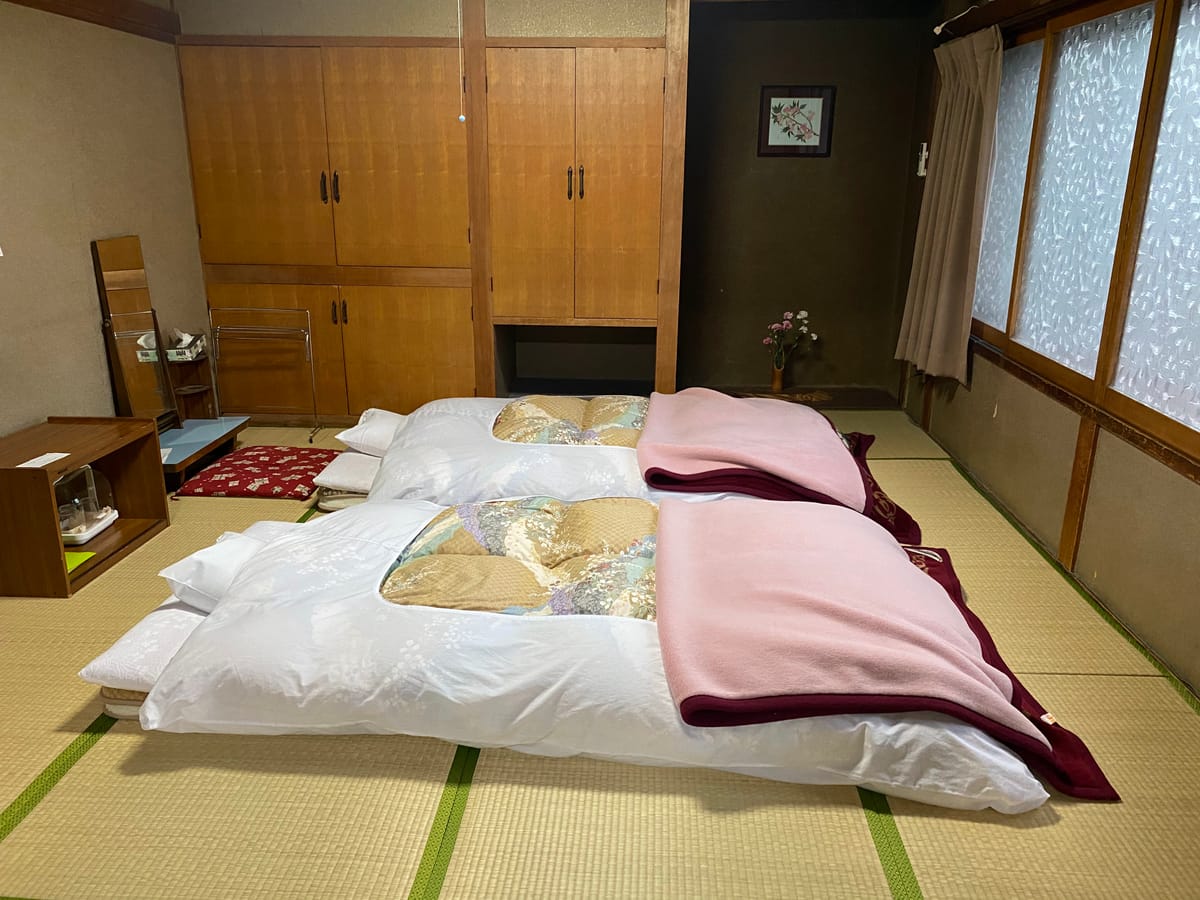
A floor and futon format, still holding on
Mimatsuso Ryokan's tatami rooms come with the full traditional package, futon bedding laid out nightly and home-style dining on site, six minutes from Heiwa dori's shops and ramen counters, making it the more central and more classically ryokan-style of the two tatami options in Asahikawa. It is the easier of the two to combine with an evening out in the shopping arcade before returning to a futon already laid out for the night. It is the safer first choice for a traveller trying tatami and futon for the first time, given how much else nearby softens the adjustment.
Tokahen takes tatami in a different direction, pairing the floor format with a communal onsen bath in a quieter, more residential setting near Victoria Station, better suited to a traveller arriving by car who wants a genuinely local stay rather than one built around the station district's rail convenience. Its distance from central Asahikawa is a deliberate trade for a slower, more residential atmosphere rather than an oversight. The trade-off suits a traveller who values atmosphere and authenticity over walkability, and who does not mind a taxi or a short drive at the start and end of the stay.
Both properties skip the amenities a modern Western-style hotel might emphasise, en-suite bathrooms, in-room televisions, elevator access to every floor, in favour of the tatami-and-futon format itself, which is the entire reason to choose either over the plainer business hotels clustered near JR Asahikawa Station. Anyone expecting a hybrid, tatami floor with Western hotel conveniences layered on top, should look elsewhere in the city. That consistency is deliberate: both properties are building toward the same traditional experience, just from different starting points within the city. A traveller who wants both tradition and modern convenience in the same room will not find it at either address, and that is by design rather than an oversight.
The choice between them comes down to priorities: Mimatsuso for proximity to Heiwa dori and a home-cooked dinner, Tokahen for a quieter neighbourhood and easier access to the Asahikawa Science Museum, but both deliver the same core departure from the city's dominant Western-bed hotel format, and both work well as a one- or two-night change of pace within a longer, business-hotel-heavy Hokkaido itinerary. Either choice rewards a traveller willing to trade a night of hotel-standard convenience for a genuinely different, more grounded way of sleeping in Japan. Whichever is chosen, both properties reward patience over speed, the opposite of the near-station hotels built for a fast turnaround between trains.
Asahikawa's efficient, rail-junction character shapes most of its hotel stock toward speed and predictability, but tatami rooms like these two hold onto an older, slower domestic rhythm, futons rather than fixed beds, floor seating rather than furniture, that reflects how many Hokkaido households still live day to day, even as the city around the station modernises into chain hotels and tram lines.